
Stretchy membranes sound simple. Until you try to build one
A membrane never stretches on its own in real life. Its elasticity is always limited by the fabric it’s bonded to and by how its pores were created in the first place.
That single rule explains why “stretchy, waterproof, breathable” remains one of the hardest combinations in performance materials.
This isn’t a marketing problem. It’s a structural one.
(Physics has opinions.)
What does “stretchy” mean?
When we talk about stretch, we’re really talking about elasticity: the ability of a material to stretch under tension and return to its original shape — again and again — without losing performance.
Simple in theory. Extremely difficult in practice.
And this is exactly where most membrane technologies hit their limits.
Where most microporous membranes stop
Most solvent-free microporous membranes on the market get their pores through mechanical stretching.
You may know them as:
- ePTFE (PFAS)
- ePE
The “e” stands for extended.
In short:
- the membrane is stretched in a 2D direction
- that stretching pulls the material apart
- micropores are created as a result
So far, so good.
But once a membrane has been stretched to create pores, there’s almost no stretch left. The structure is already “used up”.
So when the fabric is later stretched:
- the pore network distorts or breaks
- performance drops
- or the membrane simply fails
This is why most technologies end up here:
You can have micropores or you can have stretch. But rarely both.
Not a flaw. Just the natural limit of how those membranes are made.
Why pores and elasticity fight each other
Microporous membranes rely on millions of tiny, precisely sized pores. Those pores are responsible for performance and must stay extremely stable to work.
At a microscopic level, this pore network is typically rigid. That rigidity is what makes the membrane waterproof and breathable.
Elastic polymers behave very differently:
- They like to move freely
- They prefer dense, non-porous structures
Put simply: stretchy polymers want to move. Pores want to stay put.
This is why most membranes choose sides:
- microporous but mostly stiff, or
- stretchy but non-porous (hydrophilic)
How we approach the problem differently
At dimpora, we don’t create pores by stretching the membrane.
We create pores by removing tiny particles from within the structure. When those particles are removed, they leave behind, yes, micropores.
This changes the equation, greatly.
- The intrinsic elasticity of the polymer remains
- the membrane can stretch without destroying its pore structure, within the limits of the polymer used
- waterproofness and breathability stay intact
How do we make sure the pores in a stretchy polymer stay rigid and don’t collapse? That’s the magic of chemistry and our technology.
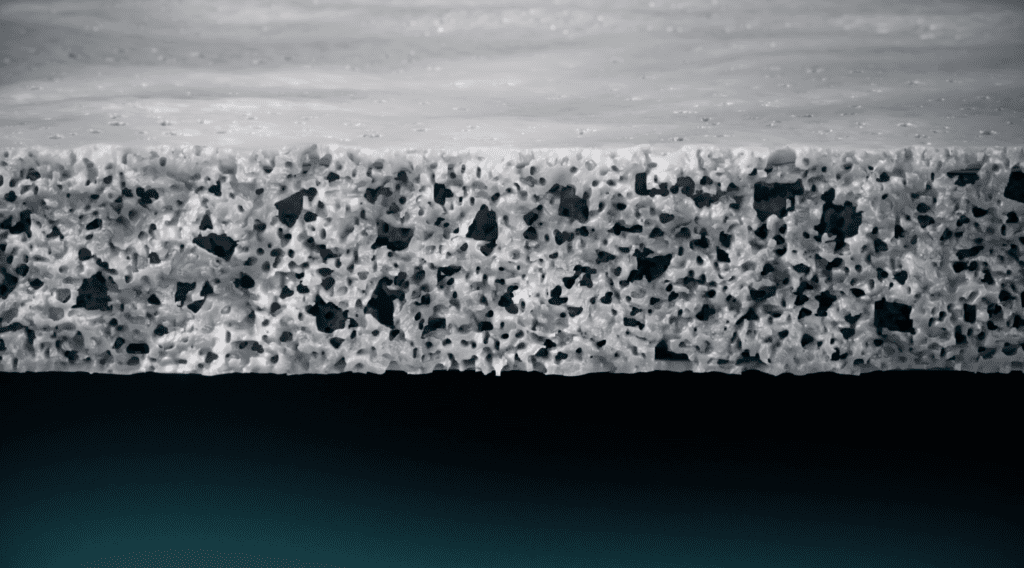
Same goal. Completely different process.
The result: microporosity with real elasticity
Our membranes combine:
- true microporosity
- high waterproofness
- reliable breathability
- significantly more elasticity than conventional microporous membranes
Not unlimited stretch. Not a shortcut.
Why everyone wants them?
Because stretch changes everything:
- Quiet movement
- freedom of motion
- Better fit
- Improved durability
- Wider application range
From outdoor and activewear to fashion, footwear, and emerging 3D garment constructions, elastic microporous membranes unlock design freedom without sacrificing performance.
And yes. We’ve made it
PFAS-free. Solvent-free.
The first bio-based (over 60%) microporous membranes on the market that is:
- highly waterproof
- breathable
- and genuinely stretchy
Not a compromise. Not a coating. Not a promise.
Just great membrane engineering.
Where this is going next
Our pores aren’t created by stretching and that gives us room to move.
New developments build on the same microporous approach, extending stretch while keeping waterproofness, breathability, and responsible chemistry intact.
Stay tuned.


